Table of Contents
ToggleSan Diego homeowners face a unique opportunity when planning bathroom remodels. The city’s coastal location, mild year-round climate, and relaxed Southern California lifestyle create specific demands and opportunities that directly influence design choices. Unlike bathrooms in humid Gulf Coast regions or freezing Midwest climates, San Diego bathrooms benefit from natural ventilation opportunities and minimal moisture challenges. At the same time, water conservation mandates, earthquake-resistant construction requirements, and a cultural preference for indoor-outdoor living shape material selection and layout decisions. This guide walks through the practical design elements and popular styles that work specifically for San Diego’s environment and building codes.
Key Takeaways
- San Diego’s Mediterranean climate and coastal proximity demand marine-grade stainless steel fixtures and corrosion-resistant hardware to prevent salt air damage, unlike bathrooms in other regions.
- Bathroom design in San Diego must comply with CALGreen water efficiency mandates requiring toilets at 1.28 gpf and showerheads at 2.0 gpm, with many homeowners choosing WaterSense-certified fixtures to reduce water use by 20-30% annually.
- Coastal Contemporary and Modern Minimalist styles dominate San Diego bathroom remodels, both emphasizing natural materials, warm neutrals, and minimal framing that reflect the region’s beach culture and indoor-outdoor lifestyle.
- San Diego bathrooms benefit from year-round natural ventilation through operable windows and skylights, reducing reliance on mechanical fans and energy costs while meeting IRC requirements for adequate airflow.
- Large-format tile installations and floating vanities require professional installation and precise substrate preparation to prevent lippage and structural failure, with proper seismic considerations including crack-isolation membranes for earthquake resistance.
- Graywater-ready plumbing and smart water-monitoring technology future-proof San Diego bathroom designs while supporting the region’s drought management practices and sustainability goals.
Why San Diego’s Climate and Lifestyle Shape Bathroom Design Choices
San Diego’s Mediterranean climate, averaging 266 sunny days annually and temperatures between 57°F and 72°F, creates design opportunities most regions can’t match. Bathrooms here rarely deal with the frost damage, burst pipes, or extreme humidity that drive design decisions elsewhere.
Natural ventilation becomes practical year-round. Operable windows can replace or supplement mechanical exhaust fans, reducing energy costs and providing immediate moisture removal. But, coastal proximity within 3,000 feet of the ocean requires corrosion-resistant hardware and finishes. Bronze, brass, and standard steel fixtures corrode quickly in salt air: specify marine-grade stainless steel or powder-coated aluminum for window frames, towel bars, and cabinet hardware.
California’s water efficiency mandates directly impact fixture selection. All new bathroom installations must meet California Green Building Standards Code (CALGreen) requirements: toilets limited to 1.28 gallons per flush (gpf), showerheads to 2.0 gallons per minute (gpm), and faucets to 1.5 gpm. Many San Diego homeowners exceed these minimums, choosing WaterSense-certified fixtures at 1.0 gpf and 1.5 gpm respectively, which can reduce household water use by 20-30% annually.
Seismic considerations affect structural decisions. Bathrooms with heavy freestanding tubs require floor framing verification, most weigh 250-400 lbs empty, plus 450-600 lbs when filled, plus occupant weight. Standard 2×10 joists at 16″ on-center typically handle this, but consult local building codes. Large-format tile installations (anything over 15″ square) need crack-isolation membranes beneath them to prevent grout failure during minor seismic movement.
The indoor-outdoor lifestyle drives layout choices. Ground-floor primary bathrooms increasingly connect to private outdoor shower spaces or soaking areas. These require proper drainage (minimum ¼” slope per foot), weather-resistant tile rated for freeze-thaw cycles (even San Diego sees occasional nights near freezing), and mixing valves with anti-scald protection rated for outdoor temperature fluctuations.
Popular Bathroom Design Styles for San Diego Homes
San Diego’s design aesthetic pulls from its geographical position, perched between ocean and desert, mixing Spanish colonial history with mid-century modernism and contemporary coastal influence. Two styles dominate current remodels.
Coastal Contemporary: Bringing the Beach Indoors
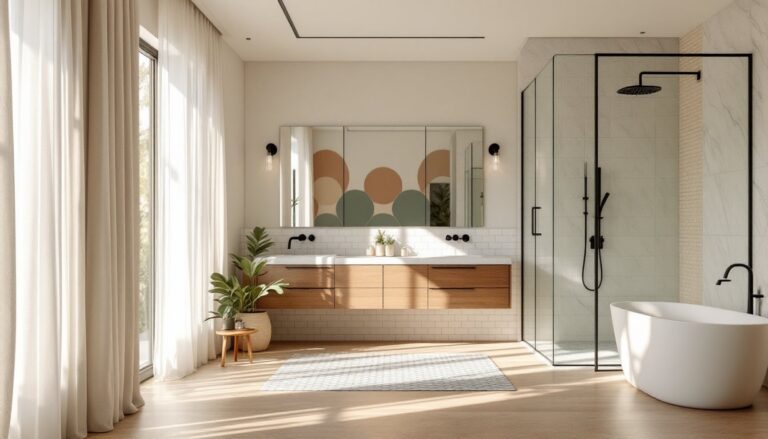
This style translates the region’s beach culture into functional bathroom design without resorting to literal nautical themes. Think natural materials and a color palette pulled from San Diego’s coastline rather than anchor-print wallpaper.
Color schemes center on warm whites, soft grays, sand tones, and muted blues, specifically the desaturated blue-greens of shallow tide pools rather than bright turquoise. Avoid stark white: San Diego’s abundant natural light makes warm whites (Benjamin Moore’s White Dove or Sherwin-Williams’ Alabaster) more comfortable and less clinical.
Materials emphasize texture and natural variation. Wide-plank porcelain tile in weathered wood looks (8″×48″ planks) mimics driftwood without wood’s moisture sensitivity. Natural stone like Calcutta marble or lighter travertine appears frequently, though homeowners should understand maintenance requirements, both need periodic sealing and show etching from acidic products. Design galleries showcase San Diego projects using these materials in unexpected applications, like stone accent walls behind freestanding tubs.
Hardware finishes lean toward warm metals. Brushed gold, champagne bronze, and matte black all work better than polished chrome in coastal contemporary spaces. Again, verify marine-grade or PVD (physical vapor deposition) coating for longevity in coastal air.
Shower enclosures increasingly feature minimal framing. Frameless glass panels (½” tempered glass minimum) create visual openness. Curbless showers with linear drains align with the style’s clean aesthetic and meet accessibility standards if designed properly (1/4″ per foot slope to drain, no transitions exceeding ½”).
Modern Minimalist with California Flair
This approach strips away ornamentation while incorporating warmth through material selection, a distinctly California interpretation of minimalism that avoids cold, austere European modernism.
Large-format tile defines the style. Slabs measuring 4’×8′ or even 5’×10′ reduce grout lines to near-invisibility. Installation requires experienced professionals, these panels weigh 80-120 lbs and crack easily during handling. Substrate must be perfectly flat (within 1/8″ over 10 feet) or lippage becomes visible.
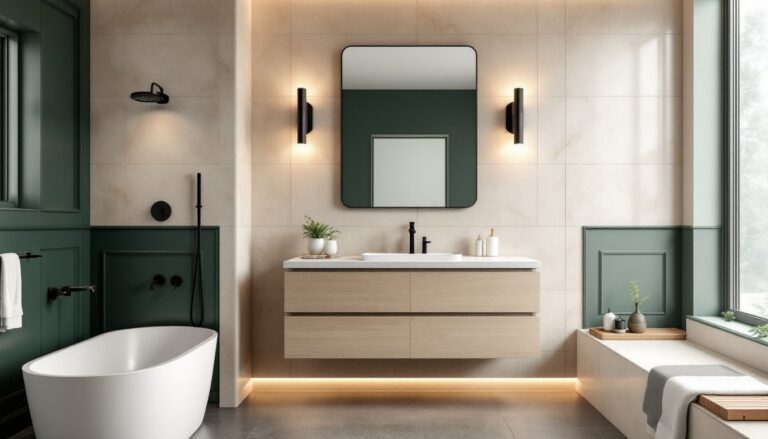
Floating vanities open floor space and emphasize horizontal lines. Wall-mounted cabinets require solid blocking between studs during framing, install 2×6 or 2×8 backing before drywall. Standard drywall anchors won’t support 150+ lbs of cabinet, stone counter, and vessel sink. These modern design approaches work especially well in smaller San Diego bathrooms typical of pre-1970s homes.
Integrated lighting replaces decorative fixtures. LED strip lighting in recessed channels, backlit mirrors, and low-profile ceiling fixtures maintain clean lines. Consider color temperature carefully, 2700K to 3000K creates warm, flattering light for morning routines without the yellow cast of traditional incandescent bulbs.
Neutral palette with warmth distinguishes California minimalism from stark modernism. Concrete-look porcelain, warm gray cabinetry (not cool gray), and white oak accents create visual interest through texture rather than color contrast. Matte black fixtures ground the space without feeling heavy.
Essential Design Elements for San Diego Bathrooms
Beyond style preferences, certain functional elements deserve attention in San Diego bathroom projects.
Maximizing Natural Light and Ventilation
San Diego’s climate makes passive ventilation practical and natural light abundant, take advantage of both.
Window placement requires balancing light, privacy, and ventilation. Operable windows should total at least 5% of floor area per IRC (International Residential Code) requirements, though San Diego’s mild climate allows exceeding this significantly. Consider:
• Clerestory windows above shower enclosures provide light and ventilation without privacy concerns
• Frosted or textured glass maintains privacy in standard window locations while transmitting 70-80% of available light
• Casement windows create better airflow than double-hung styles, they direct breeze into the room rather than splitting flow
Coastal homeowners within the California Coastal Zone may face additional permitting requirements for exterior changes. Verify with local planning departments before cutting new window openings.
Skylights and sun tunnels bring overhead natural light to interior bathrooms with no exterior wall access. Fixed skylights (non-operable) work fine in San Diego’s dry climate, though operable versions add ventilation. Modern units include insulated glazing that reduces heat gain during summer months. Size appropriately, skylights exceeding 10% of floor area can create excessive heat gain even with low-E coatings.
Mechanical ventilation still matters, even with operable windows. California building code requires exhaust fans in bathrooms without exterior windows. Choose fans by room volume: calculate cubic feet (length × width × height), then select a fan rated for 8 air changes per hour. A 5’×8′ bathroom with 8′ ceilings equals 320 cubic feet: divide by 7.5 to get ~43 CFM (cubic feet per minute) minimum fan capacity. Quiet operation matters, look for units rated below 1.0 sone.
Water-Efficient Fixtures and Sustainable Materials
Water conservation isn’t optional in San Diego, it’s mandated by code and practical given recurring drought conditions.
Dual-flush toilets provide 0.8 gpf for liquid waste and 1.28 gpf for solids, cutting water use by an additional 20-30% compared to standard low-flow models. Wall-hung models also simplify floor cleaning but require in-wall carriers (Geberit and similar systems) that add $400-600 to installation costs.
Shower valves should include thermostatic mixing and pressure-balancing features. These prevent temperature swings when other fixtures operate and maintain consistent output when water pressure fluctuates. Digital shower controls allow pre-setting temperatures and flow rates, though they require electrical connections and cost $800-2,000 installed.
Graywater-ready plumbing makes sense for future-proofing. Running a dedicated drain line from showers and tubs during remodeling allows later connection to graywater systems for landscape irrigation. Check San Diego County’s graywater guidelines, certain systems require permits while others don’t.
Sustainable materials reduce environmental impact without sacrificing durability:
• Recycled glass tile uses post-consumer content and comes in coastal color palettes
• Reclaimed wood works for vanities and open shelving (seal properly for moisture areas)
• Low-VOC paints and adhesives improve indoor air quality, especially important in bathrooms with limited ventilation
• Locally sourced stone reduces transportation impacts and often costs less than imported materials
Water monitoring technology helps track usage. Smart shower heads with flow meters and automatic shutoffs after preset durations appeal to environmentally conscious San Diego homeowners. These range from simple mechanical timers ($30-60) to app-connected digital systems ($200-400).
Remember that sustainable choices often carry higher upfront costs but lower lifetime expenses through reduced water and energy consumption.