Table of Contents
ToggleMost homeowners agonize over paint colors, furniture layouts, and throw pillows, then slap a builder-grade slab door on the bedroom without a second thought. But your bedroom door does more than separate spaces. It sets the tone the moment someone walks down your hallway, affects sound privacy, and can either blend into your design or become a statement piece. Whether you’re renovating an older home or upgrading a cookie-cutter new build, rethinking your bedroom door design is one of the most cost-effective ways to add character and functionality to your space.
Key Takeaways
- Bedroom door design significantly impacts privacy, sound control, and home aesthetics—upgrading from hollow-core to solid-core doors provides immediate noise dampening benefits.
- Popular bedroom door styles include modern slab doors, traditional six-panel designs, and barn-style sliding doors, each offering distinct visual and functional advantages for different home architectures.
- Solid-core and solid-wood doors outperform hollow-core options for sound insulation and durability, with costs ranging from $80–$200 for composite cores and $200+ for premium hardwoods.
- Black, charcoal, white, and stained wood finishes are trending in 2026—choosing the right color and finish during bedroom door design requires proper surface prep, tinted primers, and quality paint or polyurethane topcoats.
- Hardware quality directly elevates door aesthetics; invest in ball-bearing hinges, mid-range privacy locksets ($50–$150), and coordinated finishes like matte black or brushed brass to match existing home elements.
Why Bedroom Door Design Matters More Than You Think
A bedroom door isn’t just a barrier, it’s a design element that impacts privacy, acoustics, and the overall flow of your home. Standard hollow-core doors, common in tract homes built after the 1980s, weigh around 18–20 pounds and do almost nothing for sound dampening. Upgrade to a solid-core door (typically 60–80 pounds), and you’ll immediately notice better noise isolation, critical if you work from home or have kids.
Doors also define transitions between rooms. A mismatched door style can break visual continuity, while a thoughtfully chosen design ties together trim, flooring, and wall color. If you’re flipping a mid-century ranch or refreshing a Victorian, the door becomes part of the era’s visual language.
From a code perspective, bedroom doors must meet basic egress and fire-resistance standards in most jurisdictions. The International Residential Code (IRC) doesn’t mandate fire-rated doors for single-family homes, but if you’re adding a bedroom in a basement or converting a garage, check local amendments. If you’re replacing the door, keep the same rough opening size (typically 32″ or 36″ wide) to avoid reframing, which bumps up both cost and complexity.
Popular Bedroom Door Styles to Consider
Choosing a door style depends on your home’s architecture, your design goals, and how much natural light you want to borrow between spaces.
Modern and Minimalist Door Designs
Slab doors are the workhorse of modern and contemporary interiors. No panels, no ornamentation, just a flat surface that can be painted, stained, or laminated. They’re easy to clean, pair well with square-edge trim, and let bold hardware shine. If you want to introduce light without sacrificing privacy, consider a frosted glass insert in the upper third. This works especially well in homes with narrow hallways where borrowed light keeps things from feeling cave-like.
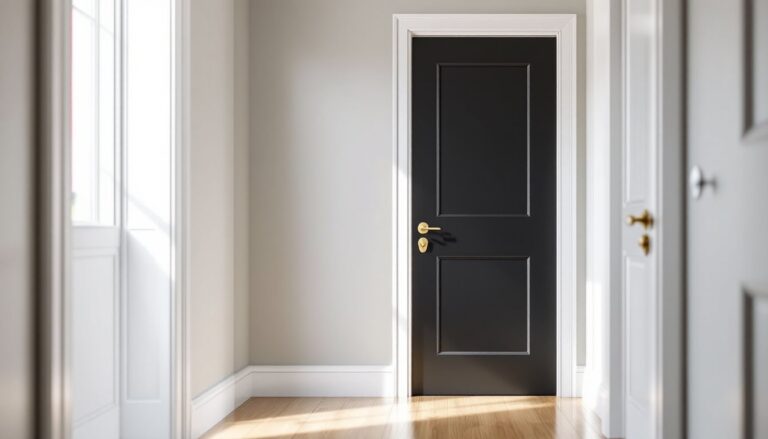
Flush panel doors offer a slight step up in visual interest while maintaining clean lines. They feature a recessed center panel framed by flat stiles and rails. Paint them in a matte black or deep charcoal for a modern edge, or go with a clear-coated walnut veneer for warmth.
Barn-style sliding doors have become a go-to in open floor plans and loft-style bedrooms. They save swing space and add a focal point, but they’re not airtight and won’t block sound as effectively as a hinged door. If you go this route, budget for quality hardware, cheap rail kits sag and drag within a year. Expect to pay $150–$400 for a solid barn door hardware kit rated for doors over 150 pounds.
Rustic and Traditional Door Options
Six-panel doors are the classic choice in Colonial, Craftsman, and transitional homes. The raised panels add shadow lines and texture without feeling fussy. They’re readily available at big-box stores in both hollow-core and solid-core versions, making them an affordable option if you’re replacing multiple doors at once.
Shaker-style doors feature flat panels with clean, recessed frames. They bridge the gap between traditional and modern, which is why they’ve taken over contemporary interiors in recent years. Paint them white for a crisp look or stain them to highlight wood grain, just make sure the undertone matches your trim and cabinetry.
For homes built before 1950, consider sourcing vintage solid-wood doors from architectural salvage yards. You’ll often find oak, pine, or mahogany doors with original hardware and glass panels. Expect to strip old paint (test for lead if the home predates 1978), plane edges to fit modern jambs, and possibly mortise new hinges. It’s more work, but the character and heft are tough to replicate with new stock.
Choosing the Right Material for Your Bedroom Door
Material choice affects durability, sound control, cost, and how the door takes paint or stain.
Hollow-core doors are built with a thin veneer skin over a cardboard honeycomb interior. They’re lightweight, cheap ($30–$80 each), and fine for closets, but they dent easily and offer zero sound dampening. If you’re on a tight budget, save them for non-bedroom applications.
Solid-core doors use composite wood or particleboard cores wrapped in veneer or MDF. They’re heavy, stable, and significantly better for acoustics. Prices range from $80–$200, depending on veneer quality and whether you choose a paint-grade or stain-grade face. These are the default upgrade for most bedroom applications.
Solid wood doors, usually pine, fir, oak, or mahogany, deliver the best sound insulation and the most authentic look when stained. They’re prone to seasonal expansion and contraction, so you’ll need to leave a 1/8″ gap around the perimeter and seal all six sides (including top and bottom edges) to minimize moisture uptake. Costs start around $200 and climb past $600 for premium hardwoods with custom profiles.
MDF (medium-density fiberboard) doors are a solid paint-grade option. They’re denser than hollow-core, won’t warp or split, and take paint beautifully. Just know that MDF is heavy and can swell if exposed to moisture, so avoid using it in bathrooms or basements prone to humidity. Pair them with a quality primer like Zinsser B-I-N to get a glass-smooth finish.
Glass panel doors or French doors work well for walk-in closets or en-suite bathrooms where you want to borrow light but maintain some separation. Use tempered or laminated safety glass if children are in the home, standard annealed glass can shatter into dangerous shards. Check local codes: some jurisdictions require safety glazing in doors.
Color and Finish Ideas to Match Your Bedroom Aesthetic
Color is where you can make a bold move or play it safe, both strategies work depending on your home’s style.
White or off-white doors are the safe bet in most homes. They brighten hallways, complement any wall color, and keep resale appeal high. Use a satin or semi-gloss finish for durability and easy cleaning. One gallon of quality paint (like Benjamin Moore Advance or Sherwin-Williams ProClassic) covers about 350–400 square feet, which is enough for 8–10 doors with two coats.
Black or charcoal doors have surged in popularity, especially in modern farmhouse and industrial interiors. They create contrast, make trim pop, and hide scuffs better than white. If you’re painting over a lighter color, plan on a tinted primer and at least two finish coats to avoid streaking.
Stained wood finishes work best on solid wood or high-quality veneer doors. Lighter stains (honey, natural oak) feel warm and casual: darker stains (espresso, jacobean) add formality and drama. Apply a water-based polyurethane topcoat in satin for a modern look, or use oil-based poly if you want a more traditional amber glow. Sand between coats with 220-grit paper for a smooth, professional finish.
For a subtle upgrade, consider painting the door a shade or two darker than your trim, it adds depth without shouting. Or go full statement and paint the inside and outside of the door different colors to surprise guests and create distinct moods in adjacent rooms.
Whatever finish you choose, prep is everything. Sand with 150-grit paper, wipe down with a tack cloth, and prime any raw wood or patches. Most DIY paint failures come from skipping this step.
Hardware and Accessories That Elevate Door Design
Hardware is the jewelry of door design, cheap hardware makes even a beautiful door feel like an afterthought.
Door handles and knobs come in passage (non-locking) and privacy (locking) configurations. Bedroom doors typically use privacy locksets. Expect to pay $15–$40 for builder-grade hardware and $50–$150+ for solid brass, ceramic, or designer handles. Match the finish to other hardware in your home (hinges, light switches, cabinet pulls) for a cohesive look. Popular finishes in 2026 include matte black, brushed brass, and satin nickel.
Hinges are often overlooked, but they’re critical for function and aesthetics. Standard hinges are 3.5″ x 3.5″ for interior doors: upgrade to ball-bearing hinges if you’re installing a heavy solid-core or solid-wood door. They’re self-lubricating and eliminate squeaks. If you’re going for a vintage or industrial look, consider exposed strap hinges or decorative butterfly hinges.
Door stops prevent handles from punching holes in drywall. Use a baseboard-mounted stop if your door swings against a wall, or a hinge-pin stop if space is tight. They cost a few bucks and save hundreds in drywall repair.
Automatic door bottoms or draft sweeps are a cheap upgrade for sound and climate control. They compress when the door closes to seal the gap at the floor. Peel-and-stick versions are easiest, but screw-on models last longer.
If you’re installing a barn door, don’t skimp on the rail. A quality soft-close barn door hardware kit prevents slamming and keeps the door gliding smoothly. Cheap kits with plastic rollers wear out fast and make noise.
Finally, consider smart locks for bedrooms that double as home offices or guest rooms. Models with keypads or Bluetooth eliminate the need to carry keys and can be programmed with temporary codes for visitors. Just make sure the lockset is rated for interior use, exterior-grade smart locks are overkill and often too bulky for standard interior door prep.